
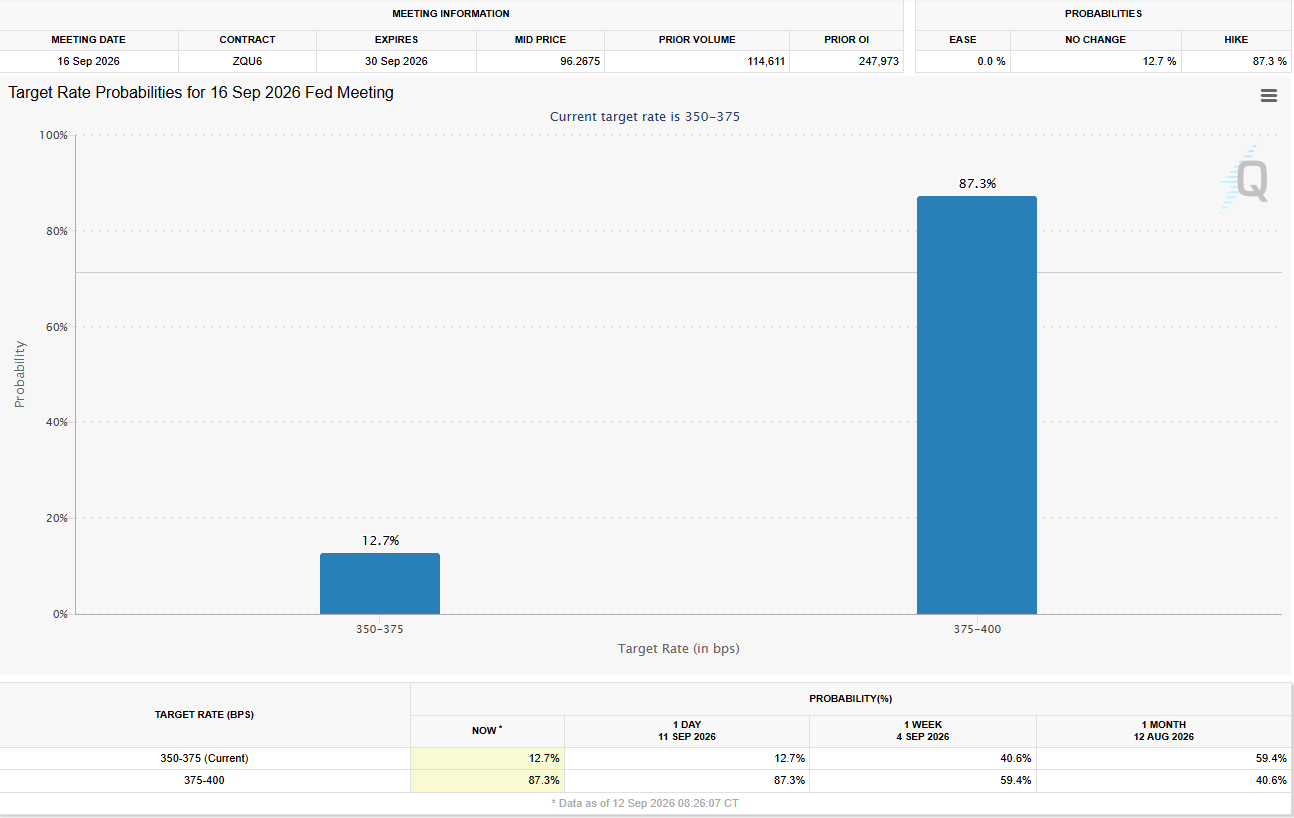
This is the CME’s fed funds futures probability bar chart for this coming FOMC announcement on Wednesday, September 16th, 2026, and it says there is an 87.3% probability that the FOMC will raise the current fed funds from a range of 3.50% to 3.75% (midpoint 3.625%) to a new range of 3.75% – 4% (midpoint of 3.875%.)
Assume we’ll see a fed funds rate hike Wednesday afternoon.
The eternal question is always how much of this is already in the bond market ? Given the yield curve shift just this past week, you can easily conclude that a big shift has already happened.
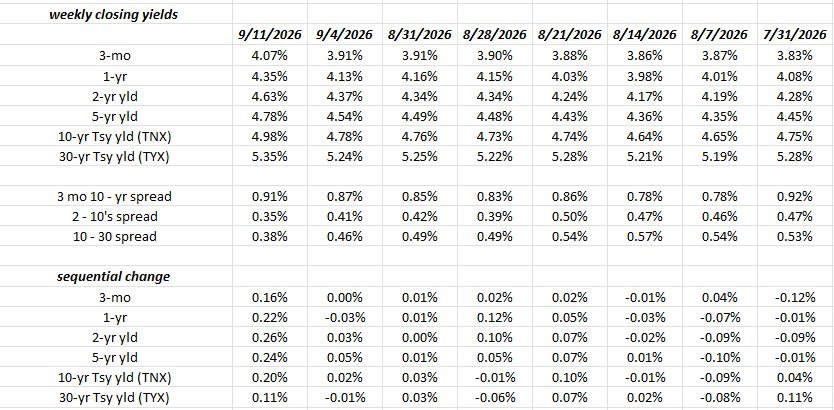
The top 1/3rd of the table shows the weekly close by key maturities since July 31 for the Treasury yield curve.
The middle part of the table shows the key spreads.
The bottom part of the table shows the change in yields per maturity each week.
The key level I am waiting for is the 10-year Treasury yield to make a weekly close above 5%. That could happen this week.
Here’s the YTD returns for some key bond market indices and ETF’s though:
- Barclay’s Agg: -1.43%
- Hi-Grade Corp: -1.52%
- High-yield Corp: +2.01%
- Muni (MUB): -1.59%
- MBS (MBB): -1.27%
- Emerging Mkt (EMB): +0.37%
Source: Bloomberg
As readers can see, it’s hardly Armageddon in bond-land yet.
In 2022, the Barclay’s Agg finished down 13%, it’s worst annual return on record, or since 1976 when the benchmark was supposedly was created.
Market Breadth:
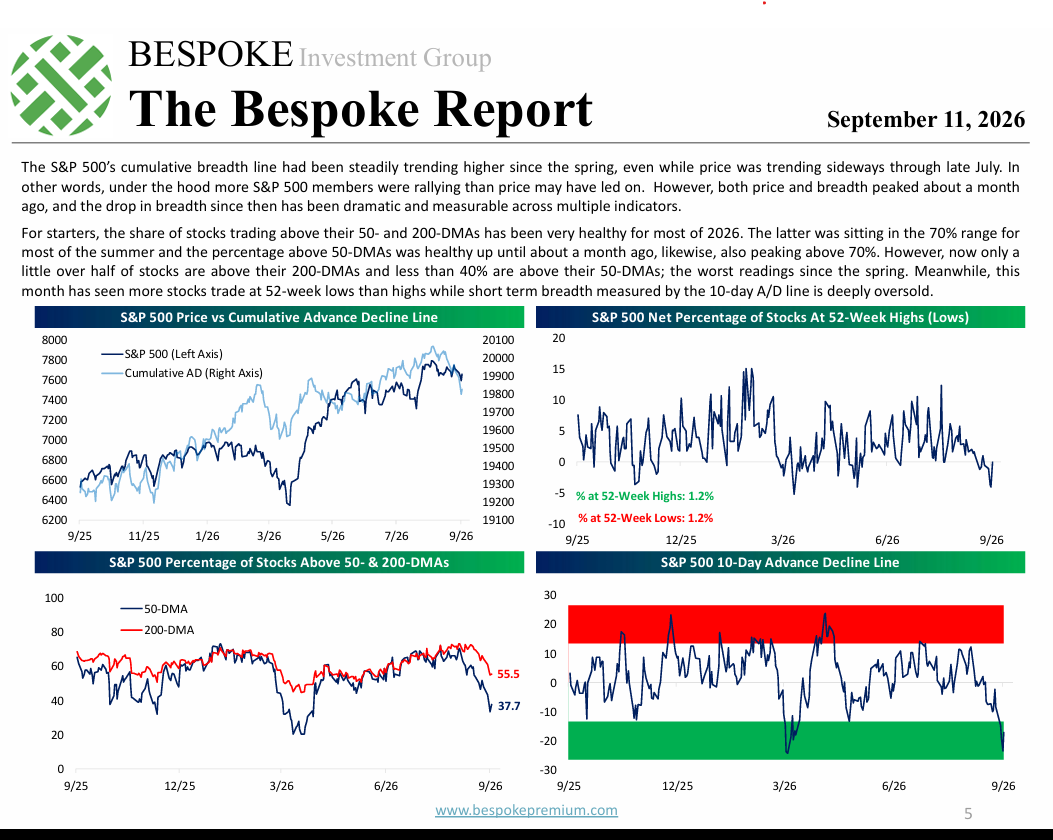
Bespoke addressed the market breadth issue in this week’s Bespoke Report, which says breadth peaked about a month ago, and now short-term breadth is very oversold, which might have accounted for the nice rally on Friday, September 11th.
Not shown is the Bespoke table that shows the weekly, monthly, 3-month, 6-month and annual returns all positive after the short-term breadth table gets this oversold.
International:
At a JPMorgan Investment Forum this past week, in Oak Brook, Illinois, David Kelly, JP Morgan’s rock-star Chief Global Strategist opened the forum with a 30-minute discussion that partially touched on international equity investing. Despite the returns on international equity funds/ETF’s, etc. which this blog discussed in this post over the long Labor Day weekend, after David took a poll of those attendee’s overweight international, not one person raised their hand.
This blog discussed international in this post on April 5th, 2026, this post on December 4th, ’25, where Japan is discussed, and November 14, ’25 in this post.
What struck me in the Labor Day blog post here, the international, 5-year, “annual” returns are still – mostly – under 10%. If a comparison were run between the 1,3,5, 10, and 15-year annual returns between the US and international asset classes, the US returns for the SP 500, Nasdaq, Nasdaq 100, would blow away international, for the 5, 10 and 15-year periods. Is that a fair comparison – probably not, but we could reasonably assume that any international rally should be able to last 5 years, particularly after a 20-year dry spell between 2005 and 2025.
Two caveats around international investing: most investors who were around for the late 1990’s and then the 2000’s, saw a 6-year period where international and Emerging Markets had relatively healthy returns, ending in 2006, and heavily influenced by China’s +15% annual growth. The US dollar will play a role in determining international returns, and with a fed rate hike scheduled for this week, it will be interesting to see what happens to the dollar after 1 pm central time on September 16th.
The point being – like any historical comparison – comparing today vs 20 years ago requires adjusting for different conditions.
None of this is advice or a recommendation but only an opinion. Past performance is no guarantee of future results. None of this information may be updated, and if updated, may not be done in a timely fashion.
Thanks for reading.