
When Walmart (WMT) reported their fiscal Q2 ’27 financial results on Thursday morning, August 20th, the stock promptly fell 10.5%, now trading below it’s 50 and 200-day moving averages.
Most analysts felt that “traffic” in the quarter was the main culprit, with comp’s of +2.6% turning in their lowest quarter since the +2.8% reported in July ’20, with average traffic rising +1.5% and average ticket – for the July ’26 quarter- rising +1.1%.
Another tipoff that points to weaker traffic in the quarter was the inventory-to-sales ratio, with sales +6% for the quarter, while inventory rose 7% y-o-y. Walmart is an incredible operator, and they don’t make merchandising mistakes too often, so for y-o-y inventory growth to exceed sales growth for 2 quarters in a row is somewhat unusual. The first fiscal quarter of the year is usually softer, even inventory turnover, given its the first post-holiday quarter, but this year both quarters have seen inventory growth outpace revenue growth.
It was a noisy quarter with the tariff refunds expanding gross margin and operating income, fuel costs impacting the P/L, and then prescription prices (the so-called maximum fair pricing) taking 90 bp’s off the quarterly comp number.
The “flywheel” aspects of Walmart’s changing business model, continued to perform quite well: global ad revenue rose 37% y-o-y, while membership income rose 17% y-o-y. To give readers some perspective on the traditional Walmart, versus the “emerging” Walmart revenue streams, Morningstar again after the latest quarter reiterated that they felt that Walmart’s “higher-margin” revenue streams will be 41% of total operating profit in 10 years, versus the 25% today (in 2026).
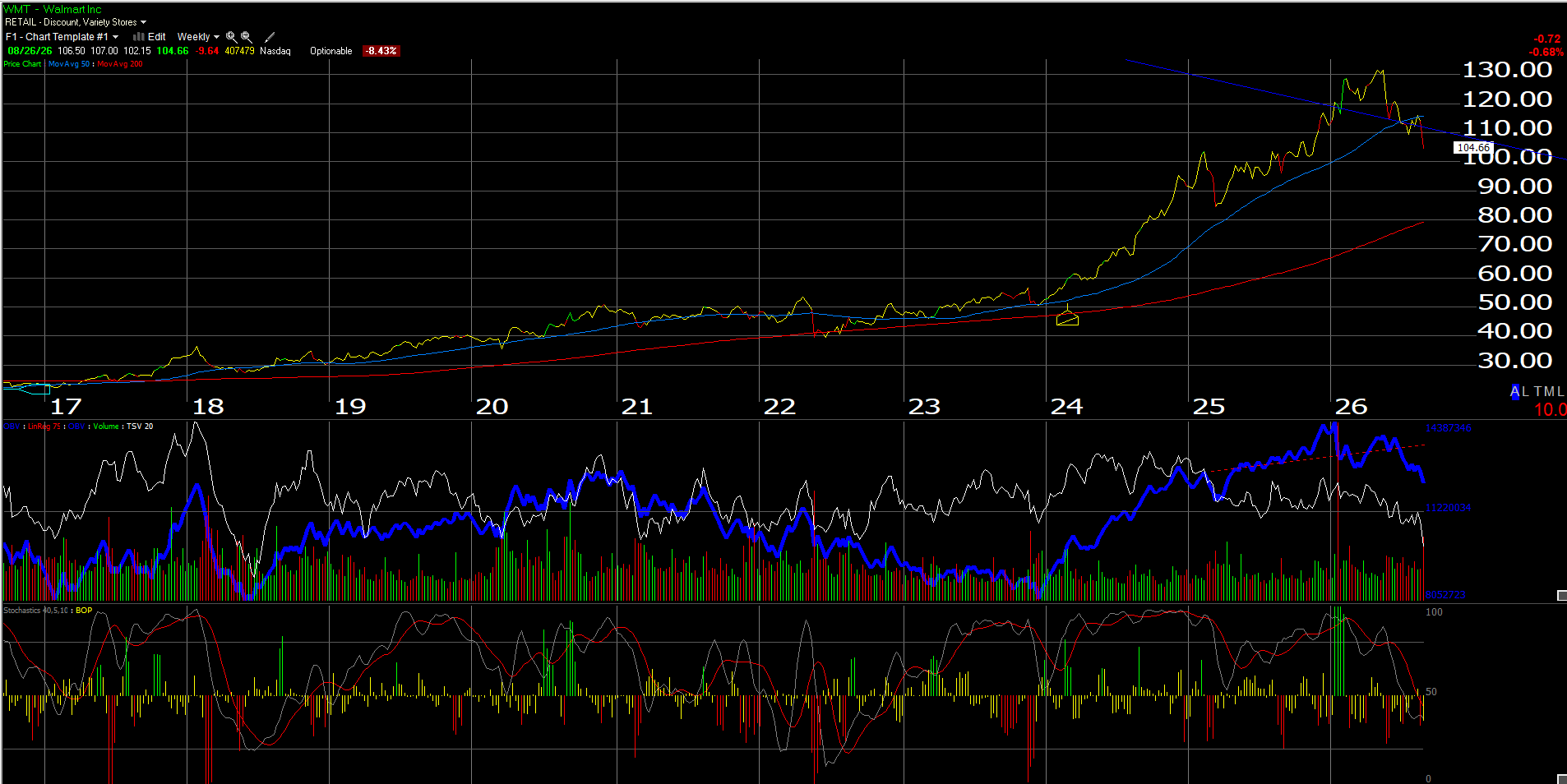
This weekly Walmart chart shows the 20% drop in the stock around the inventory overhang that impacted all retailers in 2022 (post-Covid reckoning), and then the drop in the stock again from $105 to $83 in early ’25. (Don’t recall what precipitated that stock price decline), but today we are back again looking at a 20% – 25% decline, after the weak comp’s from fiscal Q2 ’27.
Summary / conclusion: The consumer staples sector in general and Walmart in particular typically trade at lofty multiples given the consistency and stability of their earnings growth each quarter. I think it was a note out of Jeffries retail analyst, Corey Tarlow that noted that if the 90 bp’s of prescription drug pricing headwind was added back to the comp’s, Walmart would have reported a more normal 3.4% comp in the quarter.
In the Walmart earnings preview, we noted the client position in the stock and none has been sold since the 10% drop last week. In fact, this blog would add more to Walmart, if it re-tests the $100 area.
The one aspect that gives pause as an analyst, was the assumption that with success of the emerging revenue streams (i.e. the flywheel), that operating margin would expand in kind, or at the same pace, which was probably naive on my part.
But here’s the thing: Walmart’s revenue estimate for fiscal ’27 is $753 billion. If Walmart just improves the operating margin from 5% to 6%, (which is unlikely to happen in 12 months), the resulting improvement in EPS is close to $1.00 per share. (Keeping the revenue estimate of $753 bl constant, the difference of 1% in the operating margin is $7.55 billion, divided by the 7.98 billion of fully diluted shares outstanding, or about $1 on EPS.)
That’s a lot to ask for a company the size of Walmart. The difference in fiscal ’27 full-year EPS and full-year fiscal 2028 is just $0.35 per share, so analyst’s seem to be expecting incremental, or more gradual, operating margin improvement in the next few years.
However most analysts would agree Walmart’s flywheel of various revenue streams has gained traction quickly. Maybe (and that’s a big maybe) bigger margin gains are ahead if Walmart can lever those new revenue streams, better than today’s pace.
Lower US gas prices would probably be a boost to Walmart’s demographic.
None of this is advice or recommendation, but only an opinion. Past performance is no guarantee of future results. None of this information may be updated, and if updated, may not be done in a timely fashion.
Thanks for reading.