
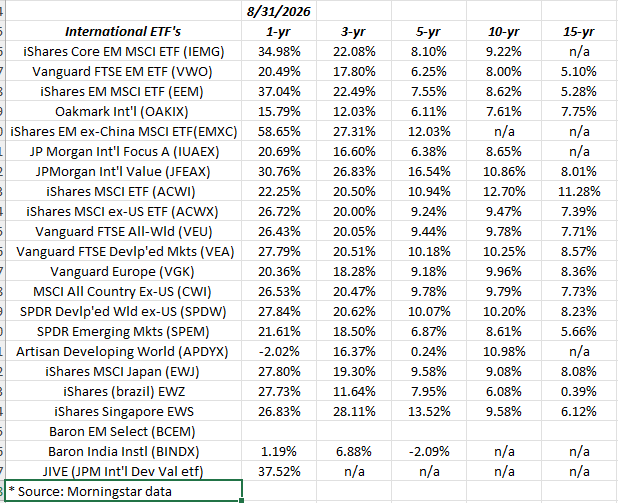
In this very un-scientific listing of annual returns for various international mutual funds and ETF’s, take a look at those 1-year and 3-year returns.
International or Non-US investing has been quietly putting up robust numbers for shareholders, without much attention from the media.
What’s interesting to the blog author is the 5-year annual return data, which mostly remain under 10%, with a few exceptions.
Comparing today’s 18-year secular bull market in the SP 500, and again looking back to the late 1990’s and early 2000’s as comparison, international, non-US and the commodity rallies didn’t really begin in earnest until the SP 500 and the Nasdaq topped in March, 2000.
It was a binary market in the late 1990’s, early 2000’s when large-cap tech and growth ruled, while international, small-cap, and mid-cap, value investing, gold, commodities, went nowhere.
Today we are seeing international, gold and even grains of late start to rally, without much give-back in the SP 500 or Nasdaq.
As of 8/31/26’s close, the SPY was up 13.08% YTD and 20.23% for a 1-year annual return, with international – per the above spreadsheet – providing substantial alpha – to the SP 500.
This blog’s largest international position the last 18 months was the JPMorgan Developed Int’l Fund (JFEAX), which now has an equivalent ETF (JIVE) for half the cost. The fund was +48% in ’25 and is still up +17.57% as of 8/31. This blog’s emerging markets exposure is the EMXC, (iShares MSCI Emerging Markets ETF), which has a 35% weighting in semi’s via Taiwan (TSMC) and South Korea, which is (how shall I say) the most watched position, and also the most uncomfortable, given the semi exposure. Japan is still top 15 position via the EWJ (iShares MSCI Japan).
If you are looking for an international value play, David Herro of Oakmark International (OAKIX), and ETF (OAKI) is still a top-notch manager, with a focus on undervalued, low-PE names, although Oakmark International has generally underperformed the international indices as the above spreadsheet indicates. David Herro and Bill Nygren are part of the Oakmark Funds, which is the best value shop in Chicago. Oakmark tends to get more valuation-oriented, and more disciplined as bull markets age.
Summary / conclusion: While the recent surge in international returns is different from the timing of the last international equity bull market in 2000 to 2006, relative to the SP 500, my own opinion is that there is still plenty of time left to generate portfolio alpha for clients with international equity funds and ETF’s.
You’ve got to be careful though: all (or rather many) emerging market funds and ETF’s are now “semiconductor funds in drag” with heavy concentrations in Taiwan, and South Korea. One of the reasons I like the JPMorgan Developed Int’l Value (JFEAX) / (JIVE) combo is the lack of semi exposure and Taiwan / South Korea exposure within the fund / ETF. Not all of the JFEAX has been sold from client accounts and replaced with JIVE given the large capital gain in taxable accounts from JFEAX’s return in 2025. The EMXC has 35% of it’s market cap in Taiwan Semiconductor, Samsung, and SK Hynix, making it very correlated to the US semiconductor and AI hardware trade.
Readers may worry about the rising 10-year Treasury yield, and the impact it would have on the dollar (likely strengthening the US dollar), and what that could mean for international returns, but given the 5-year annual return data, international outperformance is still early (in my opinion).
Using the baseball analogy, we are likely in the 4th inning of a 9-inning ballgame.
None of this is advice or a recommendation, but only an opinion. Past performance is no guarantee of future results. Morningstar is the source of all the YTD and annual return data. None of this information may be updated, and if updated, may not be done in a timely fashion.