
A lot of old bond guys – many who have been managing fixed-income money for decades – like the 10-year Treasury yield above 5%, thanks to “real returns”.
The key economic data this coming week will be the August ’26 Core PCE, due to be released 7:30 am Wednesday, September 30th as well as the September ’26 monthly jobs report due out Friday, October 2nd.
The overall August ’26 PCE and the Core PCE are expected to come in at +0.4% and +0.3% respectively. Diesel prices are included in the overall PCE measure, but obviously not in the Core PCE since diesel fuel is “energy” and food and energy are excluded in the core inflation measures.
JPMorgan’s research thinks the core PCE might come in at +0.2% down 1/10th from expectations, which would be a pleasant surprise, however the JPMorgan research piece also suggested that “methodology changes” might be contributing to the decline.
Personally I’d prefer any decline the Core PCE measure to occur on “fixed-weights” but the Core PCE isn’t calculated like that.
Several Fed Governor’s like Waller and former Governor Stephan Miran (Miran left in May ’26 with the ascension of Kevin Warsh to Fed Chair) have noted in the last month that “expected” core PCE, meaning August, September, etc. is expected to continue to decline, however they don’t tell readers or listeners why the decline is expected.
Any reader perusing this doesn’t really want to know the difference between a “fixed weight” inflation measure and a deflator, so to save time we’ll pass on greater detail, but just know that the inflation measure(s), both CPI and PCE, can vary the contents of what’s being measured based on consumer purchasing patterns and ease of substitution.
The September ’26 nonfarm payroll report is looking for 90k to 100k of “net, new jobs created” by the US economy in September ’26. Obviously, Treasury yields and the fed funds probabilities would not be served by a stronger-than-expected jobs gain. With the pop in the 10-year Treasury above 5% last week on the global Services PMI, many economists are now looking for a stronger US jobs market.
My early analyst days in the 1990’s markets, mostly under the Clinton Administration, remembers the 200k – 300k monthly net, new, jobs created, post Covid, and really post the 2008 Great Financial Crisis, these monthly jobs numbers seem downright mild when around 100k.
With a 4.1% unemployment rate, what’s left of the labor force that is not gainly employed, might be a bigger issue.
One interesting comment from a Fed Governor that surprised me was that – according to this Governor – the Fed/FOMC is not really concerned with wage inflation. Thus, as I concluded after hearing that, in the battle between wage and commodity inflation, the price of crude oil and diesel are much more important today than higher wages from a tight labor market.
The 10-year Treasury yield:
If you’re looking for a potential rally in the 10-year Treasury, this note out of Bespoke published Friday morning, September 25th, took all the juice out of an expected rally in the 10-year Treasury, given the oversold nature of the security:
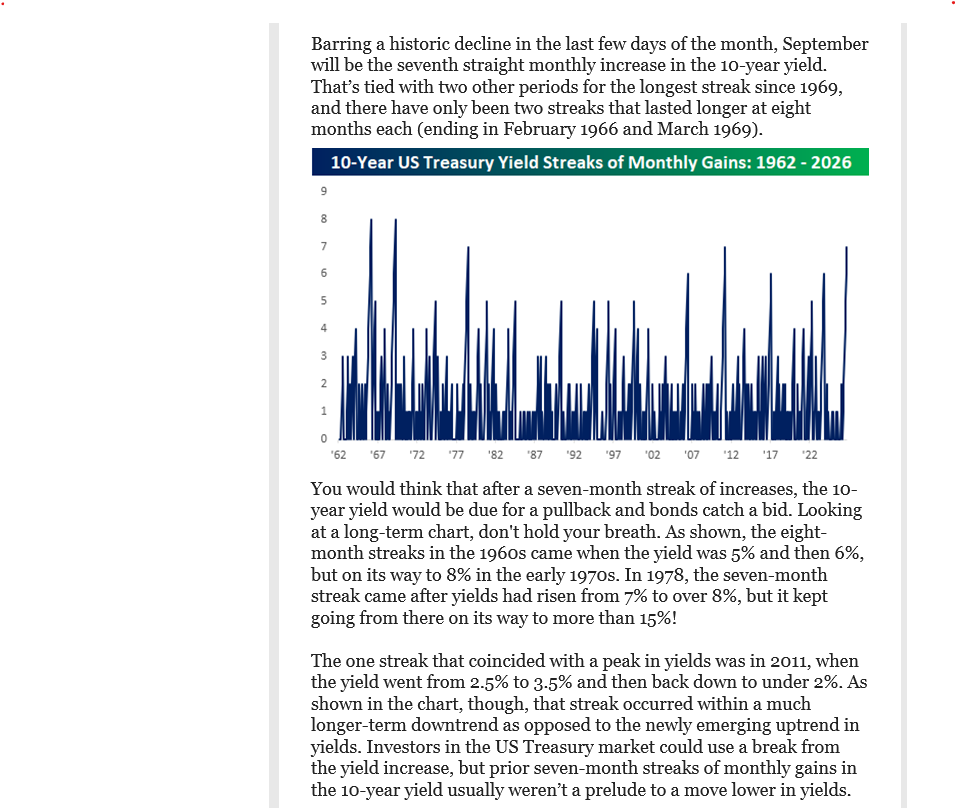
It’s the last sentence of the blurb that got me.
Summary / conclusion: Wednesday morning’s August ’26 PCE data is a big deal, particularly the latest read on the core PCE. JPMorgan thinks +0.2%, consensus is +0.3%. If forward core PCE measurements are expected to trend lower – per the many Street economists – it would be helpful to know why, is the decline from actually falling component prices, or if there is a change in methodology that will take place with September’s release, or maybe both ?
The way the consensus is leaning look for lighter core PCE and possibly a stronger jobs report.
Micron reports their fiscal Q4 ’26 quarter after the closing bell on September 30th. The EPS estimate – per LSEG – is $31.49 versus a year-ago actual EPS figure of $3.03 one year ago. That’s ridiculous growth in one year.
The semiconductor sector is having it’s best run since the late 1990’s. Despite this blog being more cautious than aggressive this year, it does look like the AI trade and particularly the semiconductor stocks have another good run to the upside left in ’26.
Since the 10-year Treasury yield contract is now through 5%, the next high tick above 5% was in June, 2007 at 5.312%. That’s not that far away. If we get to 6% yield on the 10-year Treasury, you are talking high yields not seen since late 1999, early 2000. The Treasury action has the feel of groping around in uncharted waters.
None of this is advice or a recommendation, but only an opinion. Past performance is no guarantee of future results. None of this information may be updated, and if updated, may not be done in a timely fashion. Clients and readers should gauge their own comfort with portfolio volatility and act accordingly.
Thanks for reading.