
When Oracle (ORCL) reports their fiscal Q1 ’27 tonight after the bell, the following is the sell-side consensus and the year-over-year growth expected in the key metrics:
- Revenue: $19.11 billion for an expected 28% y-o-y growth rate
- Operating income: $7.8 billion for an expected 25% y-o-y growth rate
- EPS: $1.74 in earnings per share for an 18% y-o-y growth rate
The expected financial metric growth rates are still healthy. Full-year, fiscal ’27 sell-side estimates for revenue of $89.7 billion, and $8.07 in EPS, expect 33% revenue growth, but just 6% EPS growth. Where the pressure has come from when looking at the financial statements is ORCL’s gross margin, while the operating margin has remained steady in the low 40% range.
The fiscal Q4 ’26 report which ended in May ’26, saw ORCL significantly boost fiscal ’27 capex guidance to $90 – $95 billion from the actual capex in fiscal ’26 of $55.6 billion, which is a 66% y-o-y increase. That brought the stock down from $250 to $125 (and below) by late July ’26, where it bottomed.
You can imagine what ORCL’s capex guide did to free-cash-flow (FCF) estimates for ORCL. Here’s the quarterly expectation for free-cash-flow for the software giant, this coming fiscal year :
- Q1 ’27: ($9,558)
- Q2 ’27: ($15,509)
- Q3 ’27: ($12,768)
- Q4 ’27: ($10,371)
The estimated full-year fiscal ’27 free-cash-flow loss for ORCL as of today is $45 billion, up from a $25 billion loss in fiscal ’26.
Here’s ORCL’s trailing twelve-month (TTM) actual free-cash-flow loss for the last 5 quarters:
- Q4 ’26: ($19.2 bl)
- Q3 ’26: ($13.05 bl)
- Q2 ’26: ($8.28 bl)
- Q1′ 26: ($5.7 bl)
- Q4 ’25: ($214 ml)
Since May ’22, ORCL’s long-term debt outstanding has jumped from $72 billion to $122 billion. What the negative free-cash-flow and the current credit rating have done, is completely eliminated Oracle’s stock repurchase plan. The last quarter Oracle repo’ed $4 billion was May ’22, or their fiscal Q4 ’22. To give readers some odea of Oracle’s share repurchase history, Oracle spent a total of $103 billion repurchasing shares from 11/17 to 5/22, averaging $5.4 billion a quarter.
Since May ’22 Oracle has spent a total of $5.5 billion repurchasing shares, averaging $350 million per quarter.
Oracle historically has made these big acquisitions in software spaces they wanted to participate in, with the biggest three being Cerner, Peoplesoft and Netsuite (approximate acquistion value for all three was $47 billion) with heavy “incentive stock options” (ISO’s) incentive for management to come aboard Oarcle, and then use excess cash to consume all the ISO’s and the heavy dilution after the deals were done.
This has caused Oracle’s “fully diluted shares outstanding” to rise from 2.7 billion as of May ’22 to 2.9 billion as of last quarter, May ’26, which is a drag of 7% on EPS without changing any of the income statement metrics.
Oracle’s senior unsecured credit ratings per S&P and Moody’s is now BBB-/Baa2.
That S&P rating is one notch from Oracle being a junk-bond, or below investment grade credit if that credit rating should drop to BB+.
The chart:
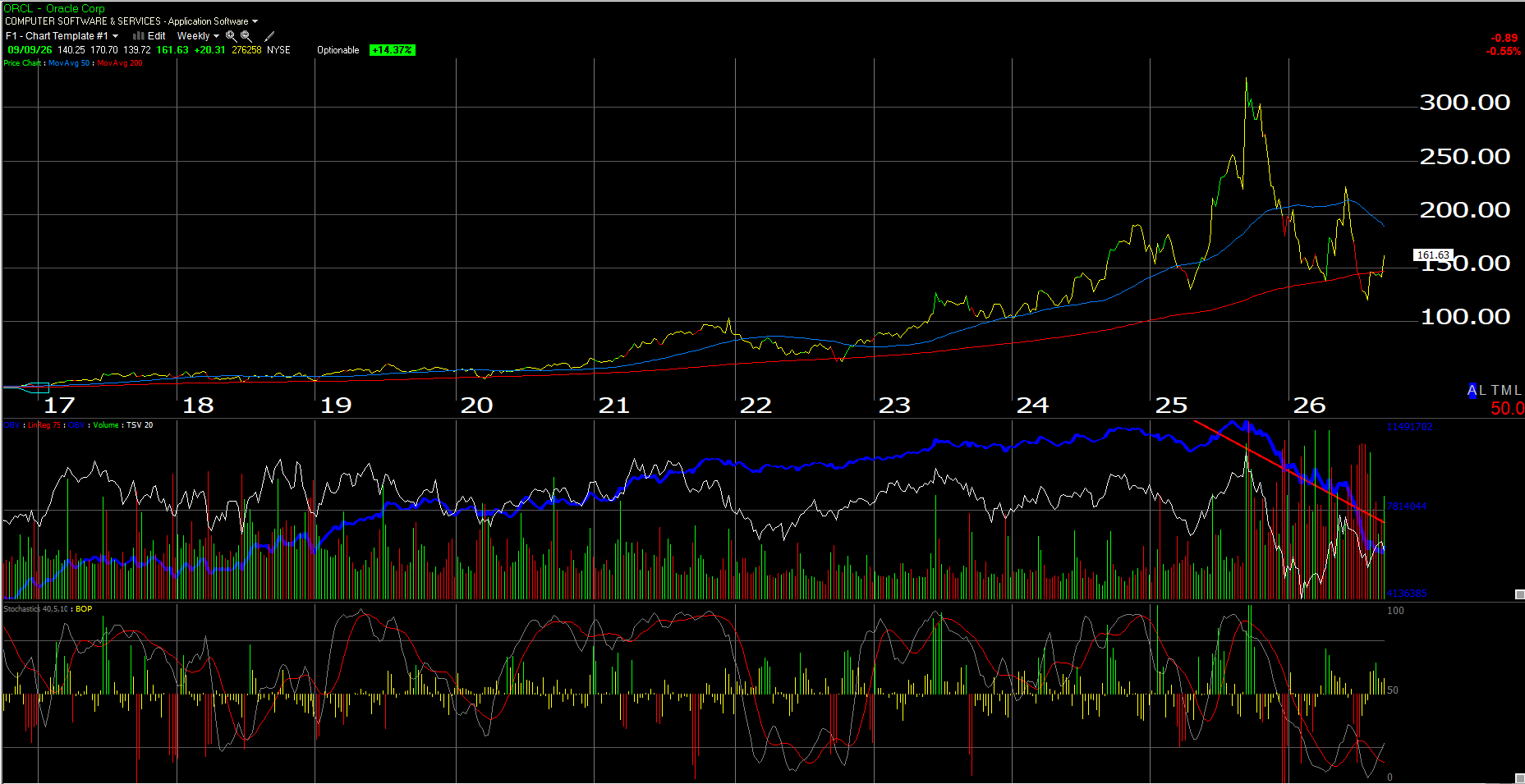
The valuation: Trading at $156 per share pre-earnings, the stock is trading at 19x, expected fiscal ’27 EPS of $8.07 for expected EPS growth of 6%. Fiscal ’27 and ’28 revenue growth is expected at 33% and 46% respectively, which surprised me given the expected 6% EPS growth in fiscal ’27.
Oracle’s forward dividend yield is just 1.24%. The TTM dividend is $5.7 – $5.8 billion, and Oracle typically raises the dividend once every two years, rather than once a year, which is more standard amongst the SP 500 companies.
Summary / conclusion: With Oracle’s stock price moving back above the 200-week moving average prior to the earnings report, it’s one positive in a sea of negatives for the former database giant. As someone who has modeled Oracle as far back as the late 1990’s, the one aspect to Oracle’s business model is – like Meta, and a few others – Larry Ellison will bet the farm to insure Oracle has a viable competitive product once the new transition to has clearly been identified.
Oracle didn’t do as well with the emergence of the cloud, but Larry and Safra Catz quickly pivoted to AI with Safra Catz departing Oracle, and the software giant now operating under a “Co-CEO” arrangement.
This blog owns very little of the stock for clients (two small positions), even though I have great appreciation for how Oracle has managed to negotiate the shifting sands of the technology environment over the last 40 years. Larry Ellison likes to win, as does Mark Zuckerberg, which adds a lot of risk to the business model.
Oracle has gone from being a database software company during the late 1990’s internet era, to the technology nuclear winter of 2000 to 2009, to trying to make a significant run at the cloud business (from 2010 to 2019), which was quickly shelved for the “emerging AI” transition, by wrecking their free-cash-flow generation and ultimately balance sheet to get there.
And Oracle could still come out of this on top.
None of this is advice or a recommendation, but only an opinion. Past performance is no guarantee of future results. None of this information may be updated, and if updated, may not be done in a timely fashion.