
Alphabet reports after the closing bell tonight, and to avoid writing War & Peace, and to keep the post short and sweet, here’s a quick rundown of the consensus estimates from LSEG and what the trends in the numbers look like:
- Q2 ’26 GOOGL rev estimate: $127 bl (gross revenue) while the sell-side seems to be around $100 bl – $102 bl for the net revenue estimate (after traffic acquisition costs) for 32% growth on gross revenue;
- Q2 ’26 GOOGL operating income: $40.4 bl at LSEG, sell-side seems to be around $40 bl, or 29% y-o-y growth;
- Q2 ’26 GOOGL EPS: $2.89 at LSEG, for 25% y-o-y growth.
One report was read that said that Anthropic was going to be re-valued upward again in Q2 ’26, with the revaluation being from $380 billion to $965 billion, which would push the EPS for Q2 ’26 closer to $8 per share. Only saw one report that noted this, so prefer to not deviate too substantially from the consensus estimates published.
Here’s what caught my eye in preparing for the Google report Tuesday, July 21, and Wednesday morning, July 22:
- 2028 consensus EPS estimate: $17.32 for expected 17% growth in 2028;
- 2027 consensus EPS estimate: $14.68 for expected 3% EPS growth next year; (not a typo)
- 2026 consensus EPS estimate: $14.23 for expected 32% EPS growth this year;
- 2028 revenue estimate: $691.3 billion for expected growth 18%
- 2027 revenue estimate: $585.6 billion for expected growth of 20%
- 2026 revenue estimate: $488.5 billion for expected growth of 21%
Capex and free-cash-flow trends:
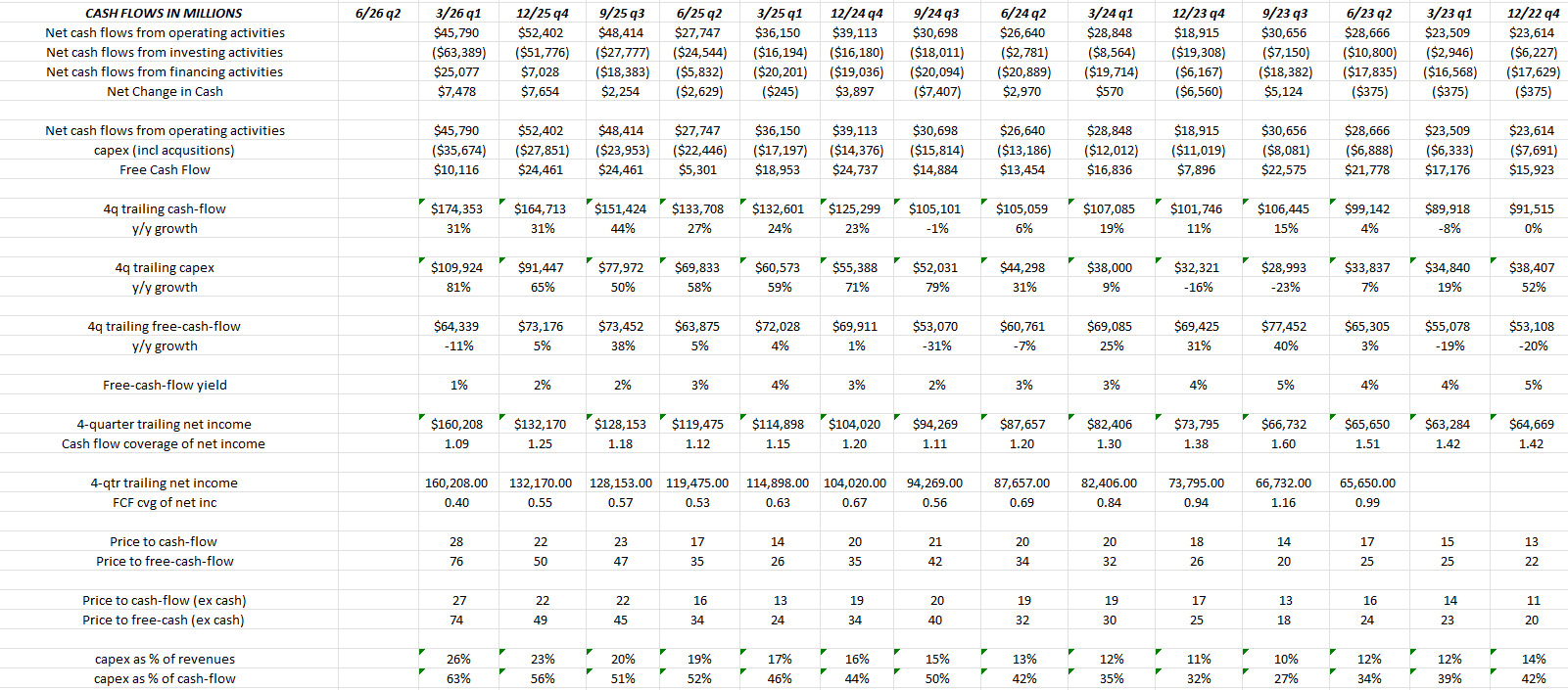
Readers can click on the above spreadsheet and take a look at the recent history (from Sept ’23) of Google’s cash-flow-from-operations statement and how this blog dissects the numbers.
The not-so surprising number is the very bottom row that shows GOOGL’s trailing 12-month (TTM) capex is now 63% of trailing 12-month (TTM) cash-flow-from operations, and free-cash-flow growth has now rolled over. This also means there will be less shares repo’ed over time, since GOOGL has raised long-term-debt to $77 billion, from just $11 bl in the March ’25 quarter, or 15 months ago. (This is not shown above but taken from the balance sheet.)
Per the LSEG consensus estimates, free-cash-flow for GOOGL’s Q2 ’26 is expected at just $90 million or essentially break-even for the quarter, after the $10 bl generated in Q1 ’26.
Free-cash-flow estimated per LSEG for Q3 and Q4 ’25 expect $6.7 billion and $2.2 bl respectively.
Quick Summary: It’s hard to stand in front of a quality communication services sector company like Alphabet that is expected to grow revenue at a 20% pace or the next 3 years.
That being said all eyes are on Google’s free-cash-flow and capex. It was surprising to read that GOOGL’s TTM capex is now 63% of TTM cash-flow from ops, which more closely resembles the semiconductor sector and the auto companies, which are much more capital-intensive sectors. The $77 billion in long-term-debt on the balance sheet was also a surprise, given it’s sharp increase, but according to LSEG data, Moody’s and Standard & Poors still rate Alphabet’s senior unsecured debt, AA2 and AA+ respectively.
The rating agencies do not look worried over Alphabet’s long-term debt increase (yet).
GOOGL is expected to grow EPS 32% in 2026, with the stock trading at 25x that expected growth for calendar year ’26, which on a PEG basis means the stock is relatively cheap. It’s the cash-flow valuations (ex balance sheet cash) that are a little pricier at 27x and 74x given the pressure to build out the data centers. This blog post from some time ago show how the EPS valuation can look favorable while the free-cash-flow valuation cannot.
Readers take note. Free-cash-flow could potentially go to zero for GOOGL, which would throw the business school valuation models right out the window.
One positive for GOOGL is the still-privately held positions within GOOGL of Waymo, YouTube and the afore-mentioned Anthropic stakes, which will likely only get marked higher in terms of their valuations, which can then boost GOOGL’s market cap. The revaluations should be treated as non-operating on the income statement and excluded from EPS and operating income, to be able to gauge how GOOGL’s core operating business is performing.
GOOGL is a top-ten holding of this blog. The stock needs to break out above $400 to break out to a new all-time-high.
My own opinion is that GOOGL should report an inline quarter or better, but the free-cash-flow statement and capex guidance will get a really hard look.
None of this is advice or a recommendation but only an opinion. Past performance is no guarantee of future results. EPS and revenue estimates are typically sourced from LSEG. Readers and clients should gauge their own comfort with portfolio volatility and react accordingly.
Thanks for reading.