
The events of the last 4 weeks around have been truly remarkable, if only because, based on the recent reporting, the original stories (from the New York Times and Wall Street Journal) around Nvidia’s CEO Jensen Huang, and the potential “honeypot” trap which resulted in Nvidia chips illegally winding up in China were patently false (at least the espionage aspect of the story), but what followed the original story, and the look into the corporate goings-on at Nvidia, left Nvidia in a very bad light.
1.) It’s clear Nvidia’s Board of Directors was (and is) weak by corporate governance standards, both reacting to the original story (although the internal affairs Jensen had with Nvidia employees have historically been adequate grounds to demand a CEO’s resignation), and the latest disclosures that have followed the original “honeypot” claims.
2.) The fact that Jensen’s kids held prominent internal positions without the expected electrical engineering or business school background smacks of nepotism, and probably an unwillingness of anyone internally to stand up to Jensen. His one daughter, the so-called “de facto chief of staff” apparently graduated from a European culinary school. This daughter’s husband, was thought to have some operational responsibility as well. There is a 2nd child – a son – who works at Nvidia – but his role was unclear as the whole mess was unfolding.
3.) The 60 direct employee reports to Jensen is another red flag, not that I would be a fan of heavily-stratified and overtly-bureaucratic organizational charts, but it seems like – for a company the size of Nvidia – and given it’s importance to one of the greatest technological advancements in modern economic history, having the company’s CEO juggling those reports and the many necessary conversations, was probably resulting in some material information falling through the cracks.
Finally, the circular financings that were thought to be negotiated as basically handshake agreements with Jensen, and the neo-clouds and other companies, could have it’s own set of issues for Nvidia, as the widening credit-default-swap (CDS) spreads indicate.
With the AI adoption resulting in such a one-sided impact on US GDP growth – the first and second reads of Q3 ’26 GDP showed “non-residential fixed investment” (essentially the AI buildout as reflected in the mega-cap 7’s capex line) accounting for the strong GDP growth – I would expect US economic growth to slow in 2027 as Nvidia is forced to adopt to the “new world”.
Obviously, all the enormous passive investors in Nvidia’s stock (like Vanguard’s SP 500 index fund and Invesco’s QQQ Trust) are going to have a say on how Nvidia is governed by it’s Board of Directors going forward, but it also makes me wonder what the passive – and active investment community – for that matter, were doing before all this hit the fan.
Was the active and passive investment community aware of any of this ? Is this corporate governance more typical and thus more tolerated for Founder CEO’s than Board-appointed CEO’s ?
Although this blog never owned Nvidia directly (or any other semiconductor company directly since the AI movement became a daily discussion in the mainstream financial media), there was (and is) exposure, although smaller now through the QQQ Trust, in primarily taxable accounts.
Summary:
The point of all this being, the prospect for US growth and US inflation moderating into 2027 as the whole rush into AI the past 2 – 3 years will moderate after the fallout of what went on internally at Nvidia, seems a logical probability for investors.
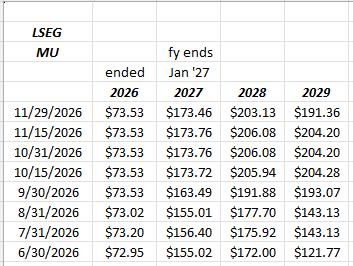
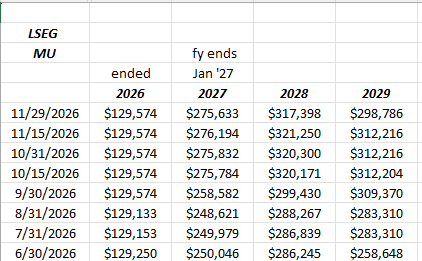
Here’s a look at Micron’s EPS and revenue revisions since last summer. Micron (MU) is scheduled to report their fiscal Q1 ’27 sometime in the 2nd half of December ’26. As a substantial beneficiary of the hardware buildout from AI, Micron has seen their actual EPS skyrocket from $1.79 per share printed in their fiscal Q4 ’24 (earnings release in December ’25) to an estimate of $38.24 today for the release in the next few weeks, for expected y-o-y growth of 700%.
For the next 3 quarters of fiscal ’27, MU’s y-o-y EPS growth is expected to be 246% (Feb ’27), 83% in May ’27, and 48% in Aug ’27.
In addition, here’s a look at the trend in MU’s EPS and revenue revisions since the end of June ’26:
Source: LSEG
The recent softening in the consensus EPS and revenue estimates for MU are not yet conclusive in terms of what fiscal 2027 might look like. It’s best to wait until after the December ’26 financial release and see what guidance looks like for the rest of fiscal ’27.
And these heady growth numbers will also be seen for Dell, AMD, Sandisk, etc. and don’t forget this doesn’t include any softening in the business from a slowdown in circular financings, a slowdown from a widening in credit spreads, and possibly a slowdown due to the events referenced above, from just Nvidia taking a breath and moving slower going forward.
This is the story of “tougher comp’s” and for tech hardware this is going to be ridiculous comp’s in the first half of calendar ’27.
This blog’s only semiconductor exposure came as a courtesy of the position in the Emerging Markets Ex-China ETF (EMXC), of which the top 40% of the ETF’s market cap was Taiwan Semi, Samsung and Hynix. This blog sold EMXC in the first two weeks of October as a result of the semiconductor concentration.
So, can bonds outperform the SP 500 and the Nasdaq in 2027 ? Yes, i do think so, since the 10-year Treasury yield peaked at 5.35% on October 5th, ’26, and even after a very hot core CPI report in late October ’26 and two quarterly GDP reports (Q3 ’26), the 10-year Treasury has not seemed to reflect any additional concern about inflation and is still trading below 5.15% and 5.35%.
I’m hoping the 10-year Treasury yield moves higher before the next FOMC meeting December 9th, 2026, so more duration can be layered in for clients. (Here’s some recent posts on the 10-year Treasury yield, and the FOMC meeting on December 9th.)
Given the bond market annual returns from the November 14th post, bonds could easily return 20%+ in 2027.
Clients are seeing the XLU, XHB, and other interest-rate sensitive sectors bought for their accounts. In terms of adding duration, the TLT, the IEF, and the JPMorgan’s Income Fund have been solid performers. Just think of how out-of-favor housing and interest-rate sensitive has been since 2022.
None of this is advice or a recommendation, but only an opinion. Past performance is no guarantee of future results. Client positions and holdings can change at any time. None of the above information may be updated, and if updated, may not be done so on a timely basis.
Thanks for reading.