
When Amazon (AMZN) reports their Q4 ’25 financial results after the closing bell on Thursday, February 5th, 2026, the retail and Amazon Web Services (AWS) giant will surpass the $700 billion in revenue mark for the first time in its history.
You can’t talk Amazon without talking Walmart (WMT), (at least I can’t) and while Walmart passed the $700 billion in revenue mark when reporting their fiscal Q3 ’26 quarter in November ’25, the fact is Amazon’s revenue is still growing much faster than Walmart’s, but slower than Amazon grew it’s first 25 years. Revenue estimates for Amazon are looking for close to $800 billion in revenue by the end of calendar ’26.
Amazon and Walmart would be two businesses that look to be set on a collision course, with the US consumer being the winner of this game of chicken, but the fact is Amazon’s AWS division accounts for 18% of Amazon’s total revenue (up from 14% in December ’22) and 20% of Amazon’s total operating profit, and it gives Amazon a substantial margin advantage over Walmart.
When Amazon reports their Q4 ’25 this coming Thursday night after the bell, analyst consensus is expecting $211.3 billion in revenue to generate $1.97 in EPS for y-o-y growth of 13% and 6%.
Like all of the big tech companies, (AMZN is actually part of the consumer discretionary sector), its capex has exploded along with the rest of the Mag-7, Mag 10-, and free-cash-flow has been squeezed. Here’s Amazon’s dollar capex and y-o-y capex growth since June ’24:
- Sept ’25: $112.5 billion or 52% y-o-y growth
- June ’25: $100 billion or 56% y-o-y growth
- March ’25: $85.3 billion or 48% y-o-y growth
- December ’24: $79.5 billion or 40% y-o-y growth
- September ’24: $74 billion or 26% y-o-y growth
- June ’24: $63.9 billion or 2% y-o-y growth
Ranking the cloud (and thus AI) operations, AWS is thought to be #1 in the space, while Azure (MSFT) is #2 and Google is #3, and has seemed to improve it’s industry position dramatically the last 12 months.
Valuation:
If the consensus estimates are met on Thursday night, Amazon will have grown EPS and revenue in full-year ’25 by 29% and 12% respectively, with the stock trading at 34x the EPS multiple, and 20x cash-flow multiple.
What’s interesting is that EPS of $8.00 expected in 2026 is just 12% growth this calendar year, on 11% expected revenue growth. Analyst’s still seem a little wary of raising calendar 2026 numbers.
Let’s look at the AWS operating margin:
Here’s the trailing average of the AWS operating margin the last 10 years:
- 4-qtr avg: 36% (through 9/30/25)
- 12-qtr avg: 32.3%
- 20-qtr avg: 31.3%
- 40-qtr avg: 29.5%
There are two tough AWS operating margin compares for investors in the next two quarters: The 12/24 quarter saw AWS with a margin of 36.9% and the 3/25 quarter saw a margin of 39.5% (which, as far as i can tell from looking at the history back to March, 2014) is Amazon’s highest AWS operating margin in history.
Morningstar has a fair value estimate on Amazon of $260, while this blog’s estimate is a closer to $300, but I have to think that Amazon has to get through the next few quarters and see what happens with the operating margin, and capex growth and if capex growth slows, can some of that free-cash-flow get put to use in share repurchases to offset dilution.
Summary / conclusion: With Amazon announcing that their Amazon Fresh and Amazon Go stores will be shuttered, and that Amazon’s brick-and-mortar retail front will now consist of the Whole Foods stores, Amazon has now put themselves in the grocery space while Walmart’s emerging e-commerce business, which Walmart noted on the last call was finally profitable (and I suspect that’s because of the international e-commerce segment), continue to try and encroach on each other’s dominant business segment and you can tell both struggle to execute in the new formats. (Walmart reports their fiscal Q4 ’26 on February 12th.)
Amazon is a top 10 holding in client accounts with a 4.5% position, and this blog has been sitting on during this period of stock underperformance since Jeff Bezos announced his resignation on July 5 ’21.
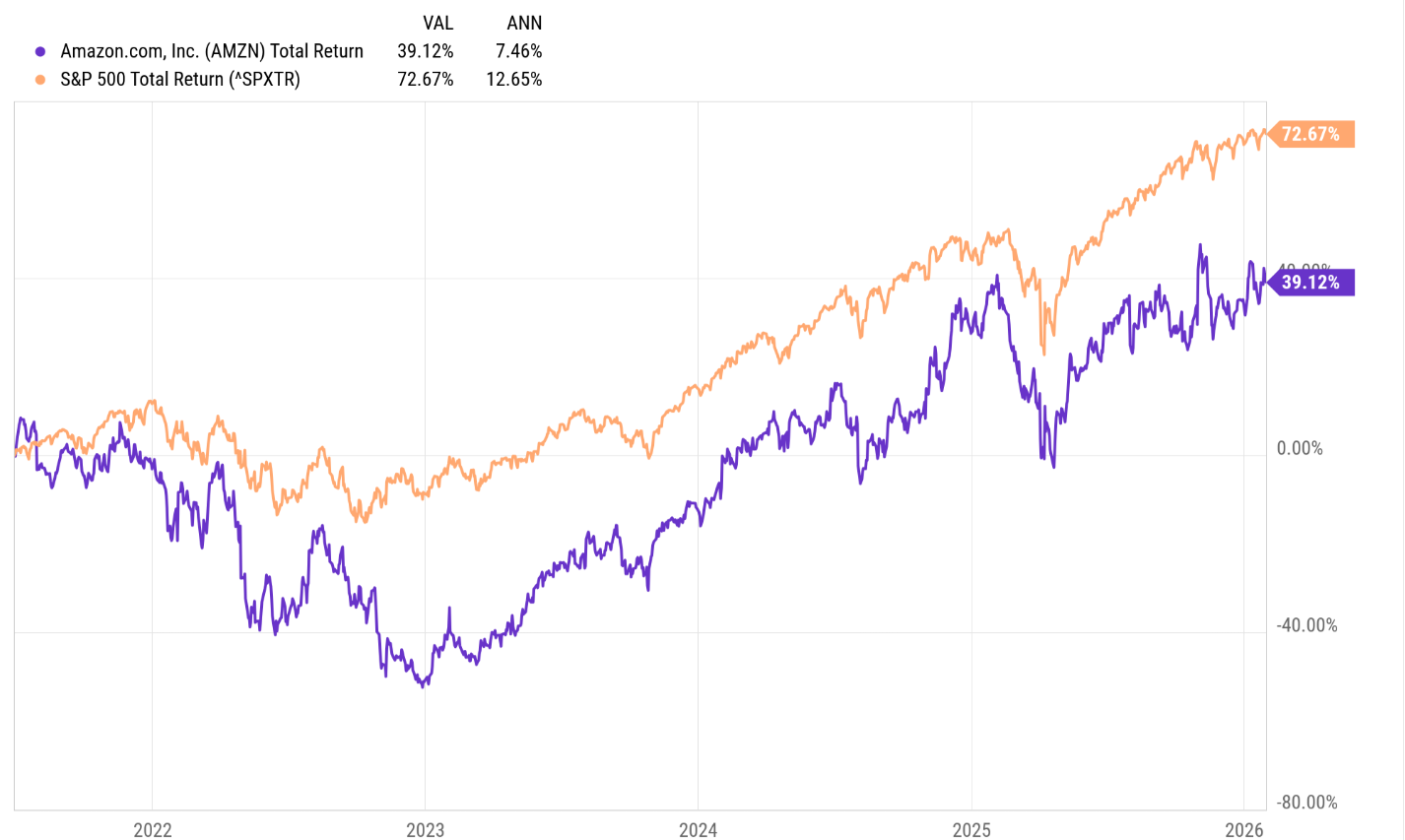
Not helping Amazon’s shareholders at all is the dilution being suffered given the sale of Jeff Bezos shares: between March, 2022’s and September 2025’s quarter, fully diluted shares outstanding rose 5%, from 10.308 billion to 10.845 billion. With free-cash-flow crimped by the AI capex surge, shareholders are eating the dilution like a kick in the teeth.
So the double-whammy of diminished free-cash-flow and rising shares outstanding, is another drag on the stock.
Technically, a trade over $250 on heavy volume Thursday night or next Friday morning, will be a technical positive for the stock. The tough compares on the AWS operating margin for the next two quarters might weigh on the stock unless 2026 guidance looks a little better than the 11% revenue growth and 12% EPS growth currently modeled by the sell-side.
Amazon grew revenue growth for 25 years in excess of 20% per year like clockwork, but that looks to have permanently slowed post-COVID. Estimated revenue growth for Amazon is just 11% – 12% the next 3 – 4 years.
The advertising and AWS segments are the two remaining Amazon divisions which are still generating +20% revenue growth.
Companies that typically grow slower after years of hyper-growth tend to start returning capital to shareholders in the form of dividends and share repurchases. The capex demands are stifling both.
The plan for this blog is to keep the stock and wait out a tough period for the retail / AWS giant.
None of this is advice or a recommendation but only an opinion. Past performance is no guarantee of future results.